

Looking back at my household bills from 2021 to 2025, I realize they reflect how my family of five has adjusted to the rising costs of electricity and water in Iloilo City. Tracking these bills has helped me understand the city’s growth, its challenges, and the choices households like mine must make.
When the Lights Tell Their Tale
In 2021, our electricity use stayed between 250 and 330 kWh per month. That level was typical for a household with air-conditioning, laptops, and appliances. What surprised me was how the bills shifted even when our usage remained steady. By 2022, the spikes became sharper. The Department of Energy reported that global oil and coal prices had surged, and those costs were passed directly to consumers through the Wholesale Electricity Spot Market 1. MORE Power, Iloilo’s distributor, reflected those changes in our monthly bills.
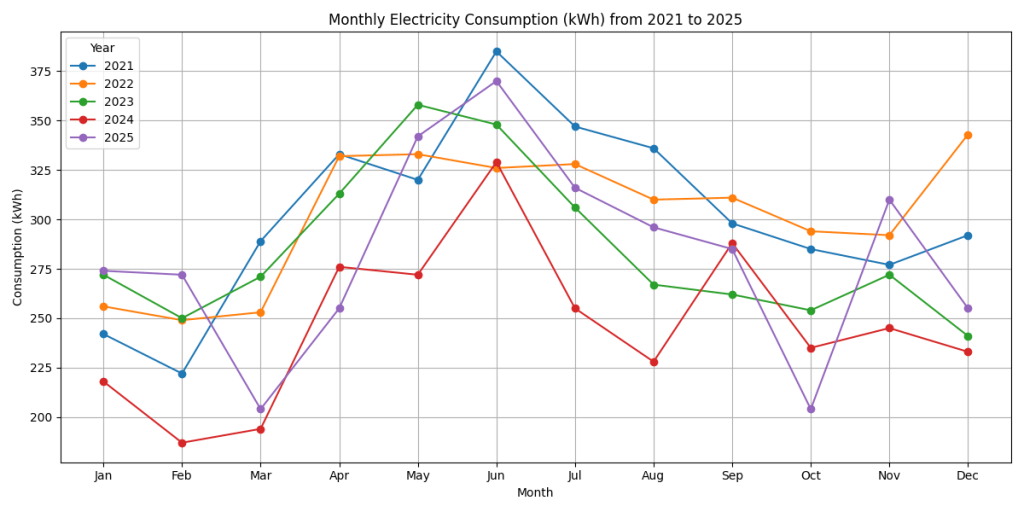
One April in 2025, our bill rose again. PAGASA recorded heat indices above 42°C, and MORE Power noted a 13 percent increase in demand2. It was clear that households across the city were consuming more electricity to cope with the heat.
When I compared our bills with relatives in other cities, I noticed differences. Metro Manila households under Meralco paid ₱11–₱14 per kWh, Cebu hovered at ₱12–₱13, Bacolod was slightly lower at ₱10–₱12, and Davao stayed more stable at ₱9–₱113. Iloilo, at ₱10.95–₱12.44 in 2025, sat between Cebu and Metro Manila.
Counting Drops, Counting Pesos
Water told another story. In 2021, we consumed about 15 to 21 cubic meters monthly. By 2024, that dropped to 10 to 14. Our habits had changed. We fixed leaks, shortened showers, and bought a more efficient washing machine. Then came the tariff hikes. Metro Iloilo Water announced increases of ₱25.20 per cubic meter in late 2025, rising to ₱28.67 in 20264. Conservation became a necessity.
Compared with other cities, Iloilo’s water tariffs were moderate. Metro Manila’s Maynilad charged higher base rates but offered broader service coverage. Bacolod’s BACIWA had lower rates but frequent service interruptions. Cebu’s MCWD faced similar hikes, while Davao’s DCWD benefited from more stable sources5.
From My Faucet to the Nation’s Ledger
The Philippine Statistics Authority’s Family Income and Expenditure Survey shows that utilities account for five to eight percent of household spending nationwide6. In our case, electricity and water consistently absorbed ₱5,000 to ₱7,000 monthly. That aligned with national averages, but inflation in food and education made the burden heavier.
The Philippine Statistics Authority’s Family Income and Expenditure Survey shows that utilities account for five to eight percent of household spending nationwide.
My bills revealed several challenges that Iloilo faces. Electricity volatility from WESM exposure made budgeting difficult. Water tariff hikes strained household budgets. Climate stress increased demand while reducing supply. Infrastructure gaps persisted, with non-revenue water and grid reliability still unresolved. Transparency was limited, leaving households uncertain about future costs.
City Hall’s Turn to Switch On Solutions
From my perspective as a consumer, the city must act. Rooftop solar and community energy projects should be encouraged under RA 9513, the Renewable Energy Act7. Net-metering rules need to be simplified so households can participate.
Energy efficiency campaigns under RA 11285 should be localized, with LGUs enforcing standards and promoting inverter appliances8. On water, the Philippine Water Supply and Sanitation Master Plan offers a roadmap to reduce non-revenue water and expand rainwater harvesting9. Utilities should also explain bills in plain language so families can plan better.
For those planning to move here, expect electricity bills of ₱3,000 to ₱5,000 monthly and water bills of ₱500 to ₱1,000 for a household of five.
Receipts as Roadmaps to Iloilo’s Future
On the personal side, I’ve realized that small changes matter. Switching to inverter appliances, sealing drafts, and using LED lights cut our electricity load. Installing low-flow fixtures and reusing greywater reduced our water bills. Rainwater catchment became a practical solution during dry months.
Budgeting also became more strategic. I now track effective rates monthly, separating usage-driven changes from price-driven ones. That way, I know whether to adjust habits or brace for external shocks.
For those planning to move here, expect electricity bills of ₱3,000 to ₱5,000 monthly and water bills of ₱500 to ₱1,000 for a household of five. Housing with good insulation, cross-ventilation, and inverter-ready circuits is advisable. Rooftop solar potential is worth considering. Backup fans, surge protection, and water storage are essential during peak demand months.
My household bills reflect Iloilo City’s growth. Electricity consumption stayed stable, but volatility made budgeting difficult. Water consumption declined, but tariff hikes became unavoidable. Compared with other cities, Iloilo sits in the middle of the utility cost spectrum, yet its trajectory demands proactive adaptation. As I file away another year’s worth of receipts, I recognize that these records are evidence of a city in transition. Unless both government and households act, the price of progress will continue to appear in our monthly bills.
References
- Department of Energy. (2023). Philippine electricity market and WESM price trends. Retrieved from https://www.doe.gov.ph ↩
- PAGASA. (2025). Heat index monitoring reports. Retrieved from https://pagasa.dost.gov.ph ↩
- Energy Regulatory Commission. (2024). Distribution utility rates and net-metering guidelines. Retrieved from https://www.erc.gov.ph ↩
- Metro Iloilo Water District. (2025). Tariff adjustment advisory. Retrieved from https://metroililowater.com ↩
- Local Water Utilities Administration. (2022). Philippine Water Supply and Sanitation Master Plan. Retrieved from https://lwua.gov.ph ↩
- Philippine Statistics Authority. (2023). Family Income and Expenditure Survey (FIES). Retrieved from https://psa.gov.ph/content/family-income-and-expenditure-survey ↩
- Republic Act No. 9513. (2008). Renewable Energy Act of 2008. Retrieved from https://lawphil.net/statutes/repacts/ra2008/ra_9513_2008.html ↩
- Republic Act No. 11285. (2019). Energy Efficiency and Conservation Act. Retrieved from https://lawphil.net/statutes/repacts/ra2019/ra_11285_2019.html ↩
- Local Water Utilities Administration. (2022). Philippine Water Supply and Sanitation Master Plan. Retrieved from https://lwua.gov.ph ↩
 Ilonggo Engineer
Leave a comment