


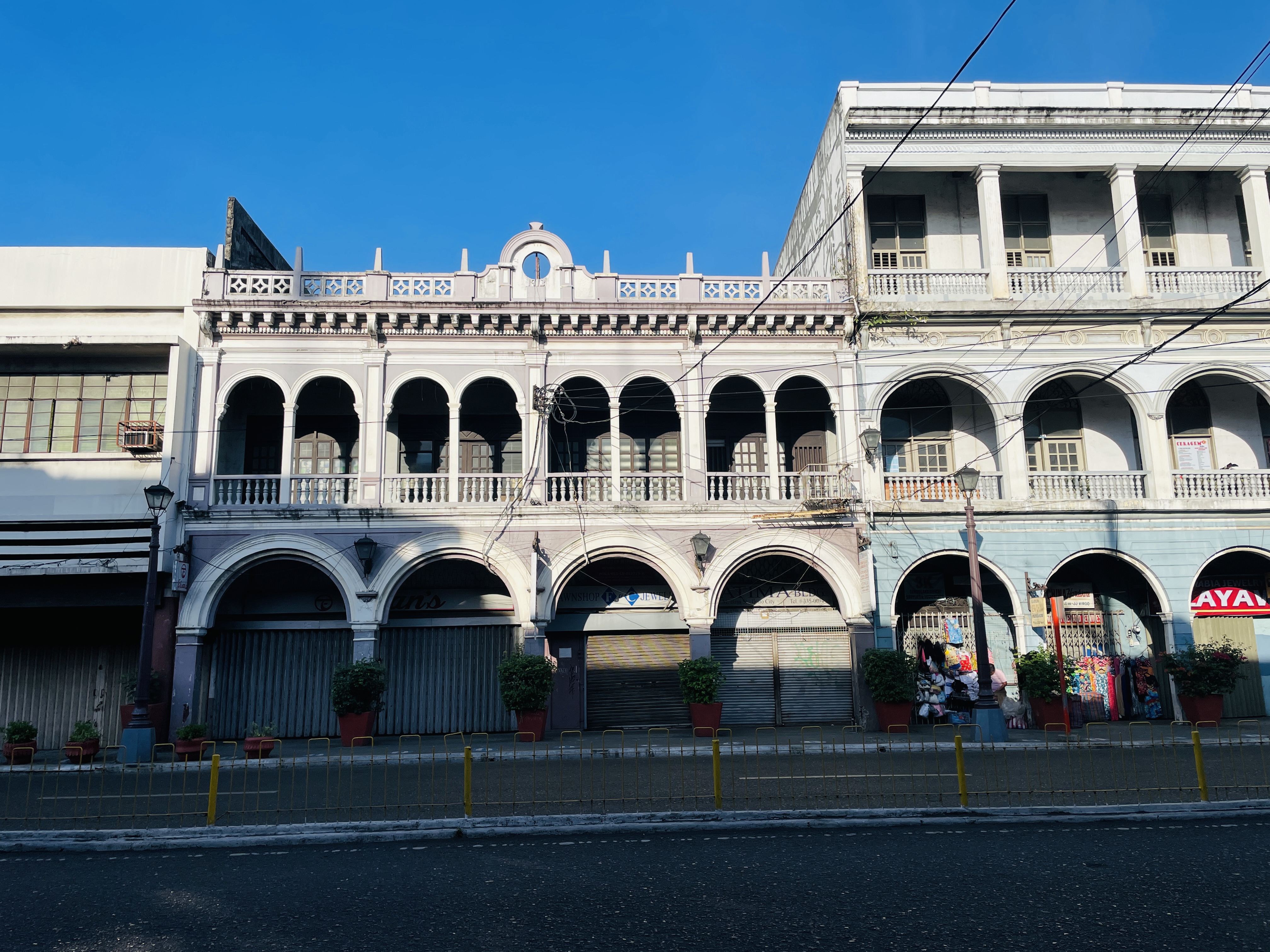
Last year, I remember that I did a modestly engaging post about the multi-decade-long proposal of pedestrianizing J.M. Basa Street, more often referred to as Calle Real in Iloilo City. Considering the local government’s effort in removing the spaghetti wires, I’ve always been imagining the what-ifs: what if we totally reimagine how we use Calle Real. Applying the lessons I learned in urban design, I am excited to share my quick conceptualization.
Brief History of Calle Real
Translated as the “Royal Street”, Calle Real is an instrumental part of Iloilo City’s heritage. It embodies centuries of commercial and cultural life. Its main function was an arterial road which, luckily, up to this day, remains dominantly lined with grandiose structures heavily influenced by neo-classical, beaux arts, and art deco architecture.
By virtue of National Historical Commission of the Philippines (NHCP) Resolution No. 3, dated June 16, 2014, this stretch of road was declared a Heritage Zone, called “Distritong Pangkomeryo ng Lungsod ng Iloilo Bilang Pook Pamana”.
Benefits of Pedestrianizing
This is not an expert or thorough analysis. Thus, I encourage experts to weigh in on the actual value of benefits. I commute daily and pass through Calle Real. I have observed an imbalance of economic activity there. Establishments in this area are usually closed on weekends. During weekdays, the life on this road begins to mellow down on certain times of the day. My frequent observation is that It feels almost dead at past 6:30PM.
Consequently, economic activity is curtailed and redirected to the New Business District in Mandurriao, where restaurants remain open until late hours. This temporary hiatus presents an opportunity to establish an evening segment of economic activity encompassing food and beverage services, experiential offerings, and other gig economy ventures.
The Concept
These are some of the before-and-after photos I envisioned of the pedestrianized Calle Real.




Analyzing the Movement Corridors
For this section, we will call Calle Real as J.M. Basa Street. This road to this day has been proven vital as it not only serves as one of the major streets to get around the city but also a major street used during the Dinagyang Festival or other festivities in Iloilo City.
In dealing with the public transportation affected, we see that a lot of the routes use J.M. Basa street. However, these can easily be diverted to Muelle Loney Street and Iznart Street. A two-way carousel movement can be done such that some routes will use Muelle Loney to enter the City Proper area and exit via Iznart Street, and vice versa.
Private vehicles, meanwhile, can still freely move through the local streets connecting to Muelle Loney Street and Iznart Street. Roads such as Aldeguer Street, Guanco Street, and Mapa Street will have drop-off cul-de-sacs.

For the festivals, it is also possible to maximize Muelle Loney Street and Iznart Street. While J.M. Basa Street will serve as the primary venue for food stalls and the central hub for pedestrian traffic, this can be effectively achieved through close coordination with public transportation and incentives for its utilization. This approach contrasts with the traditional car-pass system that still permits private vehicles within the core zones of the festivals. We just have to be optimistic that change does not happen in one event. Lessons are learned each time.
The solution for this is challenging because while it looks feasible, the major challenge will be the backlash from vehicle users who regularly pass through this road. Nevertheless, this serves as an opportunity to maximize the potential of Muelle Loney Street and Iznart Streets.
Final Word
This concept is not novel; there are numerous proposals. These are merely a few of my ideas, conceived on a random Sunday while absent from my urban design classes in Sydney. There is more potential to be realized in Iloilo City. I trust that Ilonggos are receptive to change and that more individuals will recognize the advantages of reducing car usage and promoting active travel and public transportation.
AI Declaration: The original images were taken by the author. AI was used to conceptualize the visual elements.
 Ilonggo Engineer
Leave a comment